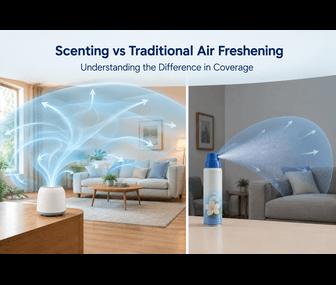
When businesses want a pleasant-smelling environment, the choice between scenting vs air freshening is not simply about choosing a fragrance. The two approaches differ in delivery, coverage, and consistency. Understanding the difference helps businesses choose a suitable approach.
Traditional air freshening usually involves products such as aerosol sprays, gel fresheners, plug-ins, or passive fragrance units. These products release fragrance into the surrounding area.
They can work well in bathrooms, offices, reception areas, and small waiting rooms. Coverage can become less consistent as space increases.
A passive product may have a noticeable fragrance close to its location but a weaker effect farther away. Aerosol sprays can provide a stronger burst of fragrance, but the intensity may reduce as the fragrance disperses. Businesses may therefore need several units or repeated applications.
Professional scenting uses fragrance diffusion equipment to distribute fragrance through a defined area. A diffuser is designed to disperse fragrance more evenly throughout its intended coverage zone.
The system can be selected according to the premises. This makes professional scenting relevant to environments such as hotels, retail stores, offices, clinics, salons, restaurants, showrooms, and other commercial spaces.
The key difference is how fragrance is distributed and maintained.
Another consideration is the experience a business wants to create. A temporary fragrance burst may be enough when the goal is simply to address an unpleasant odour in a specific room. A controlled scenting programme serves a different purpose: maintaining fragrance presence as people move through the space.
This distinction matters for businesses with customer journeys across several areas. A hotel guest may move from the entrance to reception, a corridor, a lounge, and other shared spaces. A retail customer may also move through different sections. In such settings, the coverage plan should consider how people actually use the premises, rather than treating every room as an isolated area.
Fragrance selection also needs attention. A scent that feels appropriate for a compact room may become overwhelming when used across a larger area. Consider the space, people using it, and desired intensity before finalising a fragrance and diffusion schedule.
Coverage is a key difference between the two approaches.
Traditional air fresheners generally provide localised fragrance. A freshener near a doorway may have a stronger effect nearby than in other areas.
Professional scenting considers the overall space. Equipment can be positioned and configured according to the area that needs to be covered. Depending on the system, fragrance can be distributed through air movement or diffusion points.
For larger spaces, this can provide more consistent coverage.
Yes. Building size and layout matter.
A small room may need one air freshener, while a hotel lobby, retail floor, office, or showroom has different requirements. Open areas, high ceilings, rooms, ventilation, and foot traffic can affect fragrance distribution.
Professional scenting allows businesses to consider these factors when choosing equipment. The objective is to match the system to the environment.
Consistency also matters. Traditional products can produce changes in fragrance intensity. An aerosol may smell strong immediately after use and gradually become less noticeable. A passive unit may weaken as its fragrance is depleted.
Professional systems can release controlled amounts of fragrance at selected intervals. This can help maintain consistency during operating hours.
Consistency can matter in customer-facing spaces because visitors arrive at different times.
Management can also differ. Traditional products require staff to monitor units, replace products, or apply sprays. Managing several units can take time.
A professional system centralises fragrance delivery. Businesses can adjust schedules and fragrance intensity based on operating requirements.
This does not eliminate maintenance. Diffusers still require refilling, cleaning, and periodic checks. A planned system can make fragrance management more structured and predictable.
Not necessarily. The solution depends on the environment.
A boutique, salon, clinic, or small office may need compact equipment, while a hotel or large retail space may need broader coverage.
Assess the space before selecting the system. Consider floor area, ceiling height, room divisions, ventilation, traffic, and desired fragrance intensity.
Before selecting a fragrance solution, businesses can consider a few practical questions:
These questions help determine which solution is more suitable.
Fragrance behaves differently in small and large spaces. A solution suited to a washroom may not work equally across a showroom or hotel lobby.
Businesses should select a system based on the actual space. Coverage, consistency, maintenance, and control all matter in practice.
The difference between traditional air freshening and professional scenting largely comes down to distribution, coverage, consistency, and control. Traditional products can suit smaller areas, while professional systems can suit larger or more complex spaces.
For businesses considering a Fragrance Machine in Dubai, the solution should reflect the premises, airflow, coverage, and desired fragrance experience. An Automatic Fragrance Diffuser in Dubai can provide scheduled, controlled fragrance delivery where consistency matters.
Understanding these approaches helps businesses choose a fragrance solution suited to their space, usage, and consistency requirements.

